


Remembering a visit to the old South and Dixie, in Brazil
BY JIM COCHRUN
The following account is a little-known piece of our American Civil War history that I unexpectedly stumbled upon years ago. My recall of this event was triggered when I recently attended a Friends of Boca Grande lecture by Bruce Levin about his book “The Fall of the House of Dixie.”
In 1973, my company assigned me to Brazil. One of my first duties was to call on our various factories scattered around the country. One factory was located in a little town in the state of Sao Paulo by the name of Americana. It piqued my interest as it was not a common Brazilian city or town name. I asked around at the factory and was given directions to a place where I would find answers to my question. I drove through miles of sugar cane fields and finally came upon a small, meticulously manicured cemetery. As I got closer, I spotted the distinctive C.S.A. Southern Crosses of Honor grave markers. Entering, the graves were adorned with small Confederate Stars and Bars flags. The tombstones revealed names such as: Col. William Norris, Alabama, Col. Asa Thompson, Texas, and Col. Anthony T. Oliver, Georgia.
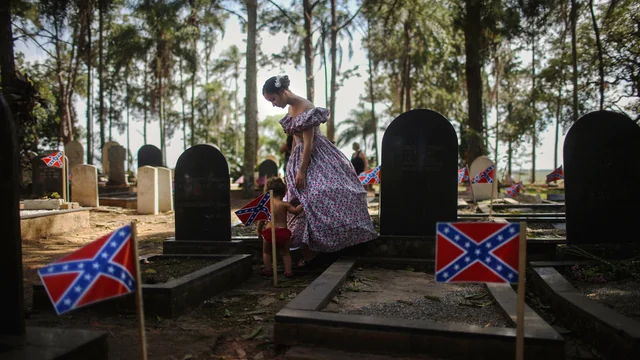
I could not believe what I was seeing, namely graves of Confederate soldiers here in Brazil. I have read Civil War material for years, but this was a chapter that had totally eluded me. I had come upon the Cemeterio do Campo (Country Cemetery) that belonged to a colony of Southerners who chose to flee their conquered nation at the end of the Civil War, undertake a 5,600-mile voyage and make a new home in a foreign land. There were around 20,000 emigres who fled to Brazil, primarily from Georgia, Alabama and Texas. Some elected to remain in the big cities like Rio, others scattered individually throughout the countryside. Most eventually returned to the states but the Norris Colony, an extended community of about 100 Southern families in Santa Barbara d’ Oeste (later Americana) flourished and endured. They were called Confederados by their Brazilian neighbors and their community was often referred to as The Lost Colony of the Confederacy.
In the years before the Civil War, some Southerners, anticipating the eventual termination of slavery in the South, began exploring moving overseas to other countries where it was still legal. Mexico, Honduras, Cuba and Brazil were among those considered. When the war ended, several Southern families concerned about postwar economic conditions and Reconstruction did make the difficult decision to leave their homes and emigrate to these various countries. Most of these overseas ventures eventually failed and these emigres returned home. An exception was Brazil, where the emperor Dom Pedro Segundo sympathized with the Southern cause and aggressively made overtures to Southerners to emigrate to his country by offering free transportation and cheap land. Many Southerners accepted his offer and sailed south in 1865 and 1866.
Today there are sixth- and seventh-generation descendants of these original Confederados dispersed throughout Brazil. The colony’s history is revered due to the many contributions that they made to the country. The emigres introduced cotton, pecans, new strains of rice and watermelon to the Brazilian fields. The high-quality cotton they produced sold in England at twice the price of Southern cotton. Contrary to the depleted soil in the South, the land here was rich and fertile and they could harvest two crops a year. They built textile mills. They brought with them spades, harrows, rakes and plows — tools that were unknown in Brazil at the time.
The Confederados also introduced crop management techniques that increased crop production. They totally revolutionized the educational system in Brazil by introducing American teaching programs. Lastly, they brought with them Protestantism and Masonry. It is often stated that their two main gifts to Brazil were religion and education. The little Campo cemetery that I stumbled upon was started as a necessity early on, as Brazil was a Catholic country and would not allow non-Catholics to be buried in public cemeteries.
On my first visit to Americana, I had the pleasure of meeting Judith MacKnight Jones, the Grande Dame of the Confederado descendants. Conversing with Judith was an absolute treat in that not only did she have an intoxicating Southern drawl, but her English vocabulary was locked in time to the mid-19th century. Judith gave me an autographed copy of a book she had just written entitled “Soldado Descanzo” or Soldier Rest. It was written entirely in Portuguese as this now was her lingua franca. The book recounts the history of their migration and the development of their community in Brazil. The title was drawn from a tombstone’s epitaph from one of the 48 Confederate soldiers buried in that cemetery.
“Soldier Rest Thy warfare o’er
Sleep the sleep that knows no breaking
Days of toil or nights of waking.”
In my discussions with Judith, I surfaced the delicate topic of slavery. She downplayed the importance of that in their community and stressed that their reason for leaving the South was not for the pursuit of the continuance of slavery. Brazil stopped the importation of slaves in 1850, but the practice was still legal until its abolishment in 1888. At least one of the Norris Colony families brought their slaves with them, but as they were so expensive in Brazil slavery never became an integral part of this community.
Three or four times a year the descendants meet for the Festa dos Americanos (Party of the Americans). The purpose is to raise funds for the maintenance of the cemetery and the little Protestant church on the grounds. The men don their Confederate gray shell uniforms, kepis and plumed slouch hats, the women in hoop-skirted ball gowns. They dance Southern reels, sing period songs and dine on traditional Southern food staples. To enter this event, you have to trade in your Brazilian Reales currency at the door for Confederate script which serves as the official tender for the event.
During my visit, Judith indicated that a year prior she had met with several other Americans who had visited the cemetery. Gov. Jimmy Carter and Rosalynn from Georgia dropped by the Campo Cemetery to visit the gravesite of Rosalynn’s great uncle, one of the original emigres and who is buried in this little cemetery.
Jim Cochrun is a Boca Grande writer and historian.
A note: Due to recent protests by anti-racism groups, the use of the Confederate Stars and Bars flag at their events has been banned by the local municipality. The descendants continue to stress that their use of the flag was only meant to honor their heritage and ancestors and carried no racial connotations.