Where Boca Grande’s past remains, right here in the present

World War I veteran created a legacy on Gasparilla Island
Above, the Red Gill Fish House, c 1935
BY KAREN GRACE, BOCA GRANDE
HISTORICAL SOCIETY
Wini Smart begins her book, “Whidden’s and Old Boca Grande,” with “Whidden’s unique draw is that chance for a last glimpse into the past.”
And this year Whidden’s is turning 100 years old.
The marina has the distinction of being listed individually in the National Register of Historic Places. The listing describes the marina as being not so much a building, but a group of historic artifacts, all nationally important, and recognized.
The marina consists of a small collection of historic resources. In the listing, Whidden’s is described as two frame vernacular primary historic buildings that support the marina. They consist of a one-story fish house and a two-story building traditionally used as a general store, kitchen and restaurant/dance hall downstairs, which has residential spaces on the second floor. The larger building, constructed between 1926 and 1933, was assembled with galvanized bolts. In addition to these primary resources, the marina contains a maintenance shop, a slip and a boat shed, all built around 1940. A water tank was added around 1925. Between 1922 and 1940, a contributing wooden dock system measuring nearly 300 feet in length, which also supported the marina, was built.
While the National Register dates the Red Gill Fish House to 1922, it is thought to have been built earlier, in 1909, by Kingsmore Johnson Sr., a harbor pilot himself and the son of Iredell Johnson, one of the early Port Boca Grande pilots. It was built on submerged land, using wooden pilings protected by concrete collars. Johnson leased the building to fishing guide Ray Futch. A large adjoining dock had fish pens where crabs and fish were held before being shipped to places as far away as the Fulton Fish Market in New York City.
In 1926, the property, which had been part of the federal military reserve as early as 1849, was purchased by Joseph Spadaro. Spadaro and Sam Whidden joined in a long-term lease and Sam began to build the additional facilities, which became Whidden’s Marina. When Spadaro died in 1952, his estate deeded the marina property to Sam Whidden.
The National Register relays that “by 1933, Whidden’s Marina became a location where sportsmen purchased bait, leased equipment and secured housing.” It also notes that an annual Boca Grande tarpon tournament, begun in 1932, “brought hundreds of sportsmen to Boca Grande in May and June each year.”
It adds that by 1936 the tournament was an international competition.
Sam, the Man
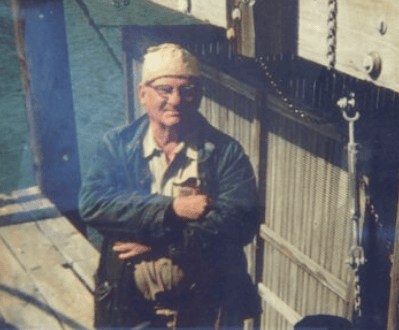
Samuel D. Whidden was born in Grove City in 1900 to Lulu and Cornelius Whidden. He had three siblings, Jake, Ruby and Hattie. The area had been platted in 1886 and a post office was established there in 1887. Wini Smart notes that Sam quit school at an early age to help his family. It is thought that he fished with various relatives who were commercial fishermen in the area, in addition to crabbing and picking fruit in local groves. Smart observes, “Although Sam had little formal schooling, he was smart, as well as friendly and personable. He made an excellent guide for wealthy sportsmen, as he knew every cove and shoal in the harbor and he remembered the good fishing areas.”
But when World War I was declared, Sam lied about his age and enlisted in the Army. He arrived in France with the first U.S. troops. Smart says that this “wasn’t the glamorous adventure he had pictured, as he spent miserable days and nights in the muddy trenches in the French countryside, being shot at by Germans.” In addition, he had been very ill on the ocean voyage before reaching France.
Returning to Grove City in May of 1919, he discovered, according to Smart, that “Boca Grande was booming,” especially The Gasparilla Inn, which “had a large workforce of pretty maids, butlers, cooks and gardeners. And they were begging for fishing guides.” Whidden came to the island in 1921 to find work in the growing seasonal tourism industry. Noting that there were few amusements for working class people except church activities, he opened a pool hall called S.D.’s Pool Hall near 4th Street and East Railroad. It quickly became a local success. And he continued as a fishing guide on his boat, Bacon and Eggs.
In 1925, Sam met Francis (Frank) and Louise Crowninshield. According to the National Register documentation, “Whidden became their trusted fishing guide and friend, and for over two decades supplied the Crowninshields’ fishing needs at Boca Grande. He maintained and made minor repairs to their boats, and served as their personal guide on fishing trips, cruises and family outings, such as picnics to Little Gasparilla Island.” Sam was also a bird hunting guide to Mr. Crowninshield when he leased an off-island property that ran from Placida through Grove City and used it to breed and hunt quail. Wini also notes that Sam often made pots of chowder for Louise’s beach parties.
In a 1981 article in the Fort Myers News-Press, David Futch described Sam Whidden as “a large man with a barrel chest and oak tree trunks for forearms.” Whidden rarely left the area. “A few trips to Tampa and a year spent fighting in World War I in France were the only times he was ever more than 100 miles from home. In the last 15 years of his life, Capt. Sam left Boca Grande twice – once to get a broken arm mended and once to have a tooth pulled.”
Whidden concentrated on building his marina. As the New-Press article recounted, “Capt. Sam began the addition that would become his labor of love. It was perfection or nothing for the old salt. Galvanized bolts were the rule. He refused to use nails. Didn’t trust them. Where one or two nails would have done the job, Capt. Sam used two or three bolts.”
“He was a perfectionist with a natural talent for putting things together exactly right,” said Sid Catlett, a local bait seller. “He would argue about an eighth of an inch where most people wouldn’t argue about a quarter of an inch,” Catlett said. “If he was building something, the board had to be measured three times before he cut it so that it would fit perfect.”
Building Whidden’s Marina
After leasing the property and the Red Gill Fish House, Sam and W. P. Polk, a Boca Grande carpenter, built the main marina building, described in the National Register as a two-story building sited about two feet from the west elevation of the Fish House. “It displays a L-shape, and contains approximately thirty-five hundred square feet of interior floor space. A jerkinhead roof surfaced with 3-V crimp metal panels protects the main body of the building. Galvanized bolts are used to assemble the wood frame wall system, which is finished with wood drop siding and cornerboards. Double-hung sash windows with one-over-one lights punctuate the walls, and a wood piling-and-concrete collar pier foundation system supports the building. Only a small portion of the rear building has brick piers. A dock system extends around three sides of the building, and connects to longer docks that extend along an adjacent finger canal.”
The interior of the building had 10-foot ceilings and included a restaurant/dance hall, a kitchen and a general store. The upstairs of the building, which was accessed by a small staircase, included a living room, five bedrooms, a bathroom and a small hall. The latter facilities could be rented out to visiting fishing clients Sam would be prepared to guide. Sam also built a maintenance shop southwest of the main buildings.
Marriage and Family and a Marina
Sam Whidden had built a business and a life in Boca Grande. Now he met, according to Wini Smart’s book, “a lovely dark-haired girl, Alice Leslie Gregory. She had come to the East Coast of Florida from Boston as a lady’s companion. When she learned that The Gasparilla Inn and the Boca Grande Hotel were both looking for winter help, she traveled by train to Boca Grande.” Miss Gregory started work as a waitress at the Inn, and then at the hotel where she met Sam. In a 2002 article in the Sarasota Herald-Tribune, Karen Parker wrote, “Sam was a charmer with a reputation as a ladies’ man. He often used offers of catching tarpon or touring the island waterways by boat to charm impressionable young women.” Wini Smart adds that Leslie also liked to fish.
Sam had worked hard to finish his marina. He now felt ready to settle down. Sam and Leslie were married in 1933 and moved into a house on Tarpon Avenue owned by the Crowninshields. Soon, they were expecting their first child. Isabelle Louise was born in 1934 and Barbara Ann a year later.
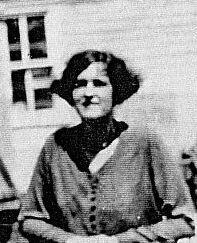
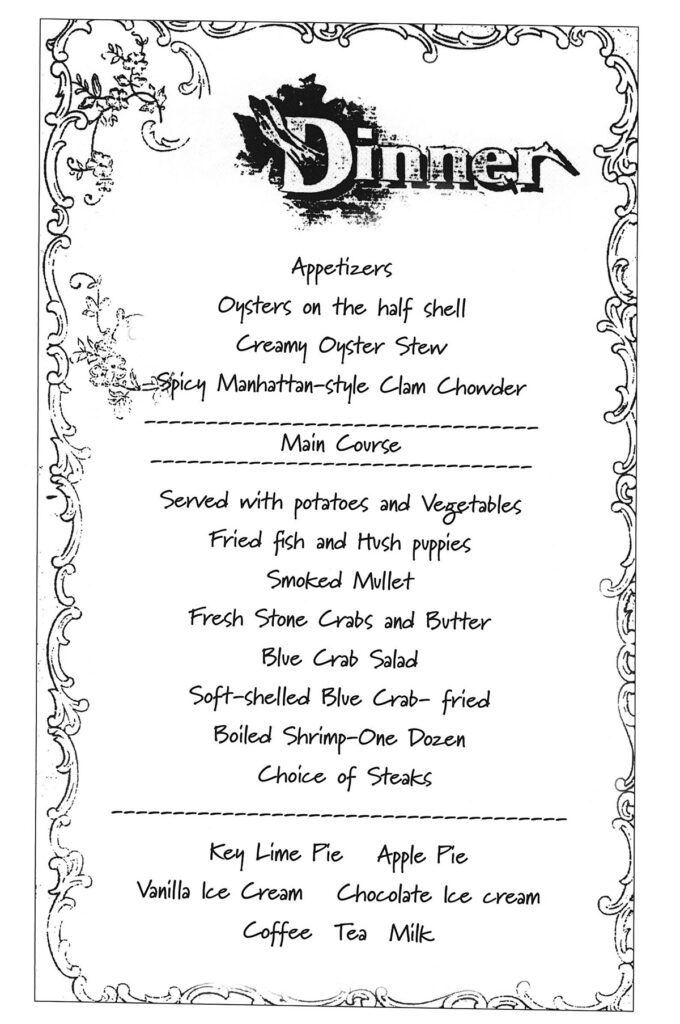
Sam and Leslie worked together, with Sam cooking his chowder in addition to guiding and maintaining the property and Leslie managing the restaurant. The Red Gill Fish House was topped with a new sign: “Whidden’s Seafood Market.” The Marina was now fully operational, selling gas, tackle and boat motors and renting dock space to boaters and fishermen. Soon the couple was hiring kitchen help. And then they opened a soda bar serving ice cream during the day and becoming a bar for drinks at night. The bar first had an old player piano, which was soon replaced by a juke box. The restaurant’s tables encircled the dance floor where there was a live “big band” and other music on weekends that encouraged dinner guests to stay and dance.
Whidden’s was popular with locals and visitors alike. In fact, it was so successful that Sam arranged for his cousin, Harry Whidden, to come to work for him. Harry not only worked at Whidden’s but met his future wife, worked at the Mercantile and ultimately started Whidden’s Grocery, the predecessor of Hudson’s.
In a 2003 issue of the Historical Society’s publication, “Connections,” Bayard Sharp recalled visiting his family in Boca Grande during a school break and going to Whidden’s to enjoy the local fun on at least one evening. “Naturally, that was the first place I went. I had a great time and met a really pretty girl. I didn’t mention it to my father, planning to return. But the very next night at dinner with the Van Burens, that cute dance partner was serving dinner. When she said, ‘Hi, Bayard, how are you tonight?’ I thought my father would go through the floor.”
Daughter Barbara is quoted in the Sarasota article as saying, “I remember Isabelle and I sleeping upstairs on a Saturday night and sneaking down to listen to the band and see all the people.” She adds, “a man named Ollie Washington was hired to do nothing but shuck and prepare oysters and clams or to clean fish.” Together Sam and Leslie were making Whidden’s a success.
Sadly, Leslie developed a kidney problem in the late 1930s and died in 1940 at the age of 37 of heart failure, nephritis and complications. Having lost Leslie, Sam decided to close the restaurant, although he opened for weddings and large parties. Several of the school proms were held there. He continued to run the marina and take care of Isabelle and Barbara. “He raised us and he was a good daddy – very strict but a good man,” Barbara remembered. “We helped out at the marina, we went fishing and swam all the time.”
As a single father, Sam decided to move from the Tarpon Street house to the Marina. That way he could watch over his daughters and the business at the same time. He had been buying and selling canned goods and meat as well as fresh seafood he caught. The restaurant was progressively replaced by a general store. Isabelle and Barbara became close with Mrs. Crowninshield, who provided dance lessons, summer camp in Maine and tuition for the Academy of the Holy Name in Tampa. She was sometimes like a substitute mother to the girls. “We would go up to her bedroom and tell her anything,” Barbara recalled.
Things changed again at Whidden’s when during World War II troops were based on the island. Sam reopened the dining room with its jukebox and added slot machines, pool tables and tables for card games for the entertainment of the military as well as the local population. Wini Smart quotes local resident Pansy Cost as saying that “Whidden’s was a regular USO,” and Patty Hobbs, who was a child, saying, “A whole crowd would drive down to Whidden’s. We’d fill that jukebox and dance and dance.”
Billy and Doris Wheeler were Sam’s friends, who sometimes worked with him – Billy fishing with Sam on Bacon and Eggs and Doris as a waitress in the restaurant. Doris is quoted in David Futch’s 1981 News-Press article, describing Sam.
“He was obstinate, hard-headed. It was his way or nothing,” Futch wrote. “He was rough on the outside, but inside he was just as kind and gentle as he could be. He was as soft-hearted as anyone you’d ever want to know and always worried about the underdog, or the person who didn’t have a break.”
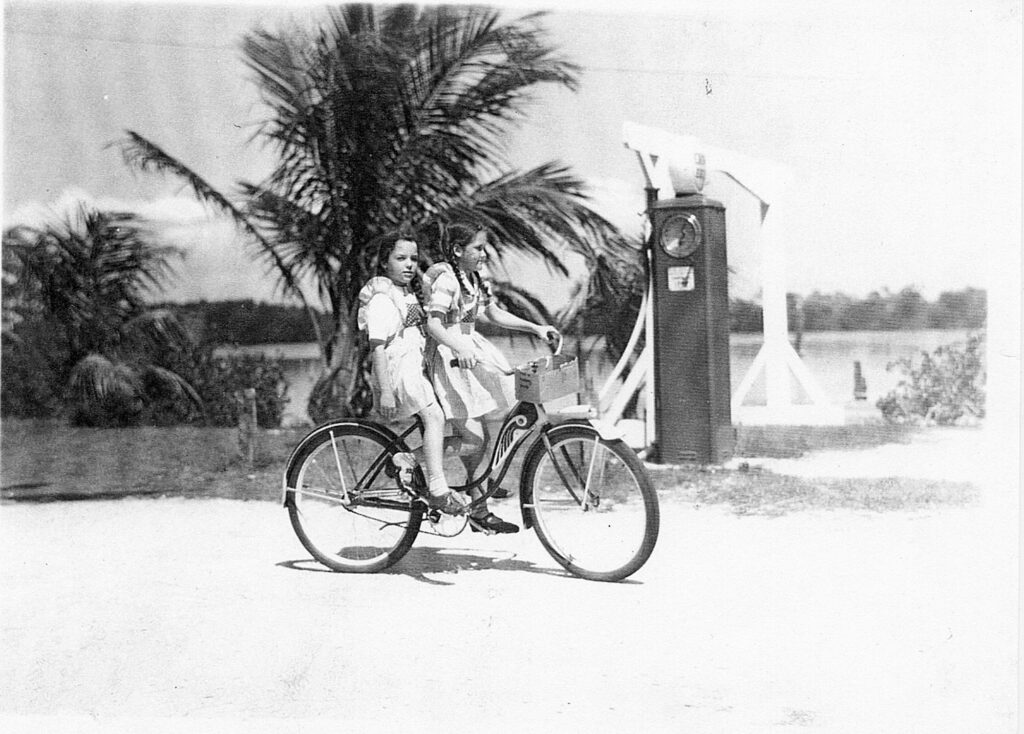
Sam’s Later Years and Death
Sam continued to fish and run the marina. He started a taxi service using the family car. Isabelle and Barbara grew up. Isabelle still helped with the bookkeeping for the marina. She married Donald Joiner, a fisherman and guide. They moved to Gasparilla Village at the north end of the island where the Joiners had lived for many years. When the village property was sold to Sunset Realty and the fishery moved to Placida, Isabelle had her and Donald’s house moved to Tarpon Street.
Barbara had left Boca Grande to go to beauty school in Tampa. While visiting a friend in California, she decided to enroll at Armand Beauty College there. She also met a retired Marine, Pete Chatham. They were married in California but returned to Boca Grande in 1967. Barbara went to work at Evelyn’s Beauty Salon and Pete found work as a bartender.
Sam died suddenly at the age of 77. He had been pumping gas when he had a heart attack. He was doing his job in the place he had built and loved. David Futch recounts that people gathered at the marina later that week and Barbara “stood on the stern of (friend Jimmy Mobley’s) boat Yo Ho and sprinkled Sam Whidden’s ashes into the bayou where her father used to feed the ducks. The spring tides did not carry his remains out to sea but pushed the shiny flakes into barnacle-encrusted pilings supporting Whidden’s Marina and home.”
Dances Restarted, Pool Tables
In her book, Smart reports that Isabelle and Barbara inherited the marina and since Isabelle had been working there and knew the business, she continued to run it with help from family and workers. One of the workers was Scott Johnson, who had moved from Michigan and worked for Sam. David Futch quotes Scott as saying that Isabelle was “cut from the same mold as her father. She has the ability to see and perceive the real you.” Wini Smart also relates how Isabelle “would help anyone in need … feeding people, letting people charge and helping them find a place to live.”
Isabelle revived the Saturday night dances, hiring The Smoked Mullet Band. Her son, Wayne, opened the pool tables each night for play. Isabelle also welcomed the shrimp boat each week and notified regular customers and the public in general when the shrimp boat was scheduled. The family and the community kept the business going so that Isabelle and Barbara could ignore offers to sell the property. David Futch quotes Isabelle: “The only reason we stay here is because Daddy built it and we love it. You can’t put a price on a man’s dream.”
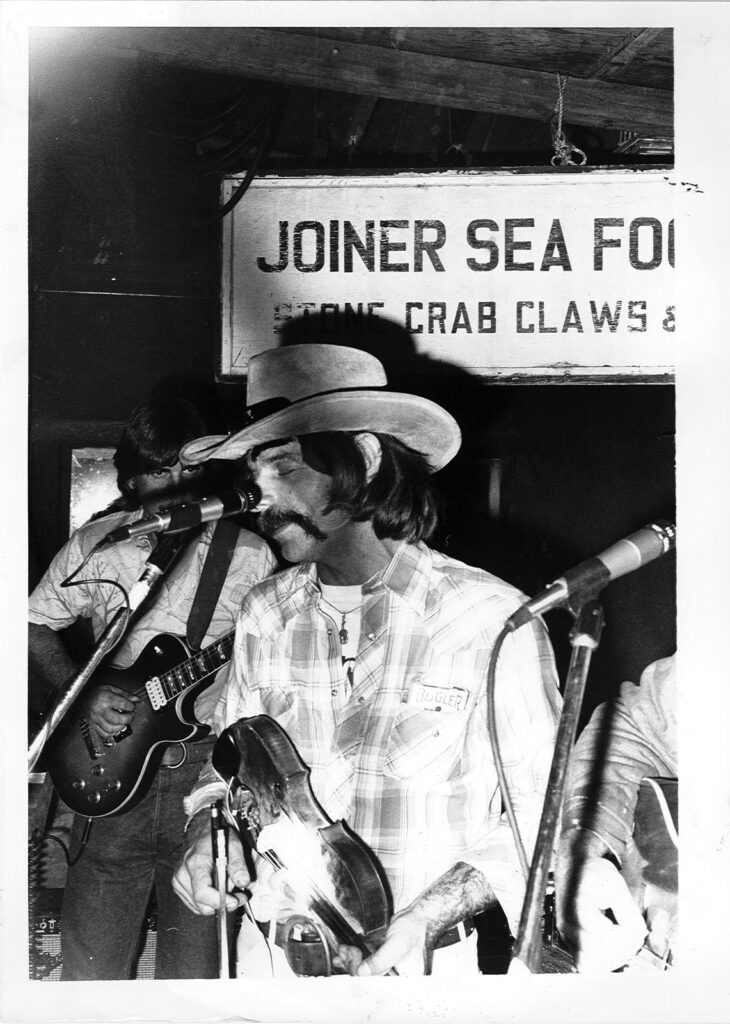
But over time, expenses rose and keeping the buildings and docks in repair became difficult. The Red Gill Fish House was listing and in danger of sliding into the Bayou. In the 1990s, Isabelle and Barbara did sell some of the property but kept the marina. Others were aware of the situation and a group of people offered to help. They had the idea of creating a museum, but the first step to doing that would be to apply to the National Register of Historic Places for their designation of the property as historically valuable. With advice of Lee County, the group hired a consultant who was able to fulfill all the informational requirements for the registration. So, on December 28, 2000, Whidden’s Marina was placed on the National Register. It would have been Sam Whidden’s 100th birthday.
Creating a Maritime Museum
The Gasparilla Island Maritime Museum was created as a non-profit with the mission of “the preservation of the marina and the fishing heritage that is vital to the history and culture of Boca Grande.” The first challenge to the organization was the repair needed to the Red Gill Fish House. The building had to be raised and its underpinnings repaired. Docks needed repair but before any of this could be done, the building which had become a storage area, piled to its ceiling, had to be emptied. The marina attic was also full. Volunteers not only emptied the materials, but sorted out historically relevant pieces.
Construction had its challenges. Bowen Construction, the general contractor, and EZ Dock Company devised a number of ways to deal with the realities of saving this old building. According to Smart’s book, Bowen arranged for huge, but sound, 25-foot timbers salvaged from a dock at the former port at the end of the island to be transported to the marina. He used these to shore up the Red Gill. “Pieces of decking were removed to allow the pilings to be placed as close as possible. Five or six strong men sank each piling by using water jets to create a hole in the mud.” Planks were put in place to support hoists that were used to raise the building and put it back into its original position. Finally, the timbers were floated to positions under the building and the tide raised them to where they could be bolted in place. “The men had to work in the water beneath the building to accomplish this. Closer to shore there was less water so they often had to work on their backs in the mud.”
Next, they installed new electrical wiring, heat and air conditioning. The roofs of the Fish House and the connecting docks were replaced. A cleaning company cleaned the inside with soap and water as pressure washing could have damaged the original paint. Finally, the building was treated for termites.
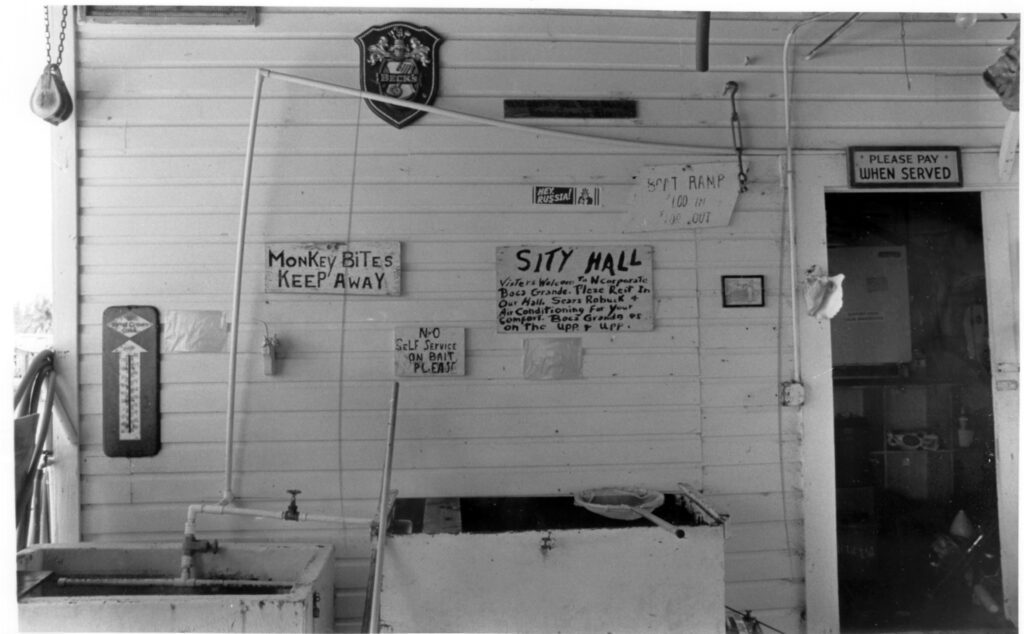
Meanwhile, Barbara and Isabelle had old photos duplicated. Stored items were labeled and readied for display. The objective was to maintain the look and feel of the original Whidden’s within the museum. The museum opened in May 2001, with Barbara Whidden Chatham as its curator. It contains fishing equipment and other relics of the island’s maritime history, as well as signs and photos from fishing and marina history. The museum also sponsors and operates several fishing tournaments each summer, recreating that tradition that started early in the life of the facility. This year they included the Red Gill Invitational, the Howl at the Moon, the Ladies’ Howl and the Gasparilla Island Kids Classic.
The Whidden family continues to operate the marina facilities. Sadly, Isabelle and Barbara have both died – Barbara in 2012 and Isabelle in 2018. The next generations of the family continue to own and run Whidden’s.