


Bocilla Conservancy expands programs

Above, conceptual rendering only of the proposed Conservancy building. Photo submitted
The Bocilla Islands Conservancy has acquired nine properties in its 10 years, worth more than $2 million, with the goal of preserving the island chain’s natural habitat; now they are raising funds to purchase a permanent building to house their conservation initiatives.
There are eight members on the 501C3 non-profit’s Board of Directors, including Board President Ember Harker.
“Our goal is basically conservation and the education of the community because if you just conserve the land and you don’t teach them why it matters, then it doesn’t matter,” Harker said. “You’ve got to teach people how to do conservation in their own lives and their own properties.”
The Conservancy combines property acquisition with educational programming. It owns properties throughout the Bocilla Island chain, including Don Pedro Island, Knight Island and Thornton Key. Although the Conservancy’s realm of representation includes the broader Little Gasparilla Island area, it typically does little programming on LGI because it does not own property there.
Additionally, they manage four conservation easements and seven West Coast Inland Navigational District properties, one of which is over 20 acres and houses a bee apiary.
“We have a beekeeper that comes out to the island and when bees get under people’s houses, instead of taking them, because what used to happen is people would just take them off the island, but bees are super important and we need bees,” Harker said. “So, we just relocate them out of somebody’s house and over here.”
As with the land that houses the apiary, each property owned by the Conservancy is dedicated to a different animal or initiative, such as the bat lot.
“It has an educational sign about bats and how important they are for our ecosystem,” Harker said of the parcel. “And it also has a bat house that we constructed in conjunction with the local Girl Scout troops. So, it’s a fully functional bat house on the property that you can see. And then you’ve got an educational sign. We’ve also got an owl lot. So, an owl house and an owl sign.”
They also own and maintain three parks. Eco-education Park & Island Conservancy (EPIC), locally known as the Gnome Garden, showcases native plants and is geared toward family use and education. Additionally, they have the Marine & Pollinator Park and the Hammock Trail.
Now, the Conservancy is in the process of trying to acquire a permanent residence for their operations.
“We only own property; we don’t own any space,” Harker said. “And there’s a couple of reasons for that, but the one that is the biggest reason that best aligns with our mission is that we’ve been able to acquire nine properties in 10 years. The first property we acquired was $60,000. The most recent property we acquired was $175,000.”
Many properties left are landlocked lots, but they are selling for over $200,000. Harker said that buying properties is great, but as there are fewer and fewer properties, they’re more and more expensive.
Having a building would serve three main purposes for the Conservancy, Harker said. It would give them more credibility as a non-profit, offer some long-term stability and allow them to expand programs.
“Our vision is to create a home for the Conservancy that feels rooted in the island’s history but also built for the future,” she said. “We hope it becomes a place where people can connect, learn and take part in protecting the character and natural beauty of this community for generations to come.”
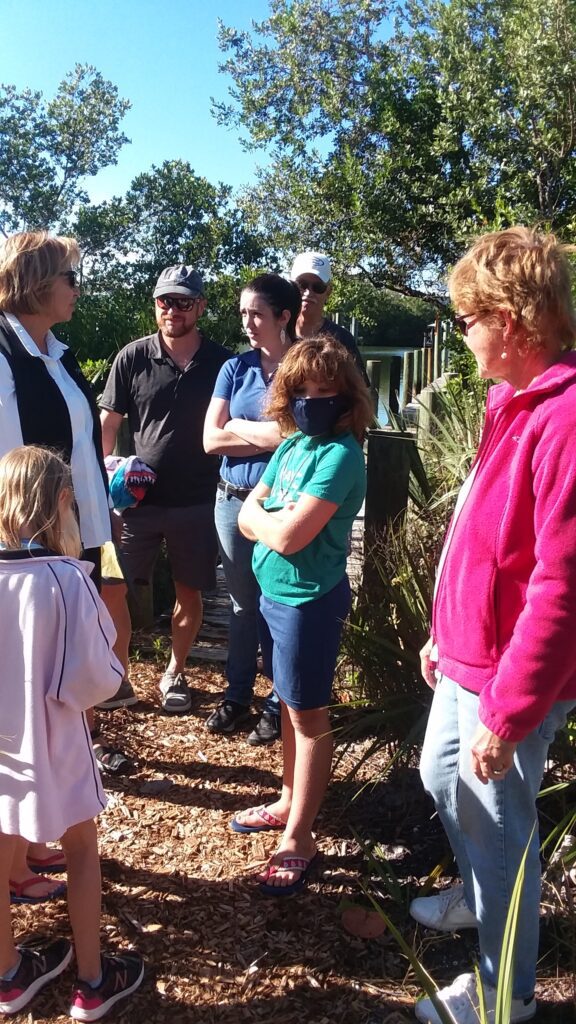
There are three Certified Florida Master Naturalists on the board: Linda Cotherman, Jude Smith and Kelly Lube, who is also pursuing a Master Gardener status. All three are currently working toward an Advanced Florida Master Naturalist certification.
“We have people that have taken the time to really dig in deep and educate,” Harker said. “And now we’ve built all these amazing programs … that we can now basically invite people into and take out into the broader community.”
Some of their programs include a vertical oyster garden program in partnership with Charlotte Harbor Environmental Center; a large-scale shoreline restoration; and their Living Lecture series which includes food, drinks and a presentation from a local expert on the protection of barrier island ecosystems, land conservation or local wildlife.
Being able to invite people to participate in these programs requires an established location.
“We bought nine properties in the first 10 years,” she said. “If we keep going at the same trajectory we’re at now, in the next 10 years, we will buy two. That’s a big shift. Buying two properties in the next 10 years does not sound like enough to me. When they created our island, if they had platted it today, there would have been room for parks, and green space, and places for gopher tortoises and all of that. They didn’t. I mean, they made every single inch of this island a buildable lot effectively.”
The Conservancy has located an existing building on a property that they are interested in, built by Bob Butcher, one of the founding members of the island. Located at 130 Gasparilla Way, the property is currently under contract and inspections are underway.
“It is 24-by-24-foot. So, it’s on this big lot,” Harker said. “The building itself only takes up something like 15 percent of the total square footage … It is a simple building. It’s going to be very easy for us to maintain. It’s very small. It’s basically one big room which for us is perfect. It doesn’t need a ton of renovations. We’d be able to use it pretty quickly. So that’s the building we’re looking at.”
They have raised about $116,000 of their initial $150,000 goal. For the second part of their two-pronged fundraising campaign they are asking people to become monthly donors.
“It’s something like, if you do a hundred people at $70 per month for three years, it pays off the building,” Harker said.
Currently, the Conservancy is also doing a legacy brick campaign in which donors can reserve a commemorative brick that will become a permanent part of the Conservancy Center. “We’d love to include some friends from Boca Grande in it,” she added.
“We’ve kind of hit a ceiling,” Harker said, “and it’s like, how do we get to that next level? And the way we get to that next level is with qualified people, amazing partnerships and amazing programs. And we leverage that to get into larger and deeper funding sources and utilize that to buy more property. We’re not just trying to buy a building because we want a clubhouse, like that’s not the point. We are trying to also make the property – you know, first and foremost, it’s a conservation center – but we’re also trying to make it a wing for the community by allowing other very small gatherings of strategic groups or other nonprofit boards.”
Event in August
The Conservancy is hosting a fundraiser at Scarpa’s Coastal in Boca Grande on Saturday, Aug. 1 from noon to 2 p.m to introduce the people behind Bocilla Islands Conservancy, explain more about their work, answer questions and connect with others who care about protecting the islands we all call home.
There will be an interactive cocktail experience where guests can craft their own Berry Mojito, available with or without alcohol; a hands-on gnocchi-making class, led by a chef; plus a seafood salad, signature flatbread and dessert.
Visit bocillaislandsconservancy.org/scarpas to purchase tickets for the event. Tickets are $225 per person.


