


Retail sales plunge 50 percent, $8.5 to $4.1 million

Figures for summer are in
Newly released sales tax data from the state of Florida shows a dramatic falloff in summer sales reported in ZIP code 33921, which includes Gasparilla Island and Boca Grande.
In July 2026, gross sales reported in ZIP code 33921 totaled $7,312,934, compared with $12,139,961 in July 2025, a decline of about 40 percent. In August 2026, preliminary gross sales totaled $4,104,364, compared with $8,489,223 in August 2025, a decline of about 52 percent.
The data was requested for the past three years. The state provides aggregate totals by ZIP code and does not break the figures down by individual business or specific type of purchase. The data comes from Florida Department of Revenue sales and use tax returns. The state’s Form 12 data reports gross sales, taxable sales and state sales tax due by ZIP code. The figures can be revised.
The state’s reported sales tax due encompasses all the state sales tax liability reported on sales and use tax returns to the Department of Revenue, after applicable exemptions, deductions and adjustments are accounted for. It is not the same as gross sales or total money spent by consumers, but overall, it is an indication of the total spending related to the zip code.
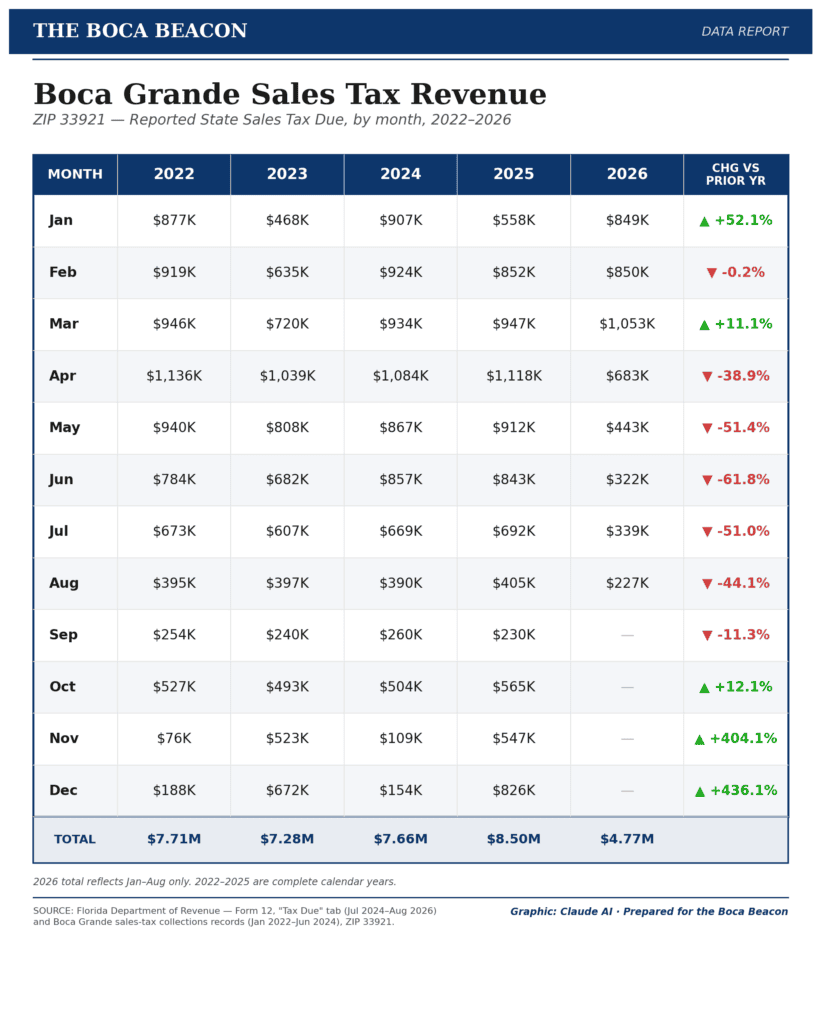
The decline also is reflected in the amount of state sales tax due. June 2026 shows state sales tax due of about $322,000, compared with about $843,000 in June 2025, a decline of about 62 percent. July shows state sales tax due of about $339,000, compared with about $692,000 in July 2025, a decline of about 51 percent.
August 2026 has preliminary data and could be revised. So far, it shows about $227,000 in state sales tax due, compared with about $405,000 in August 2025, a decline of about 44 percent.
In the spring, the Beacon published a chart using older data going back to 2022. From 2022 through 2026, with the exception of periods affected by storm closures, the sales figures have been relatively consistent.
The high season for 2026 from January through March was consistent with or ahead of the previous year. Gross sales in January were about 53 percent higher than January 2025, February was about 1 percent lower and March was about 12 percent higher. The declines began in April. Gross sales were down about 15 percent from April 2025, while state sales tax due was down about 39 percent.
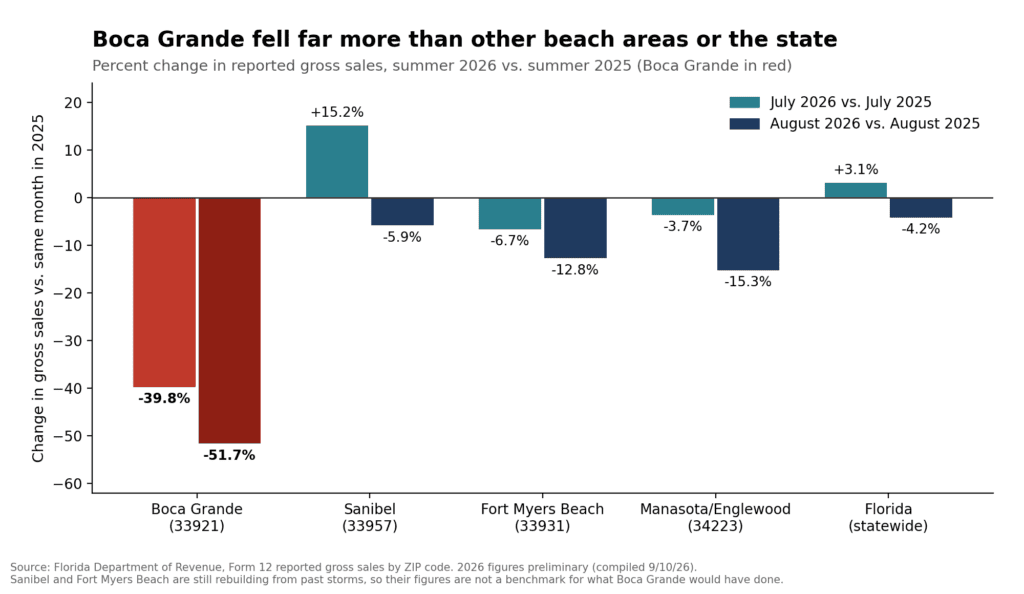
The Beacon also ran a chart comparing reported gross sales statewide with selected barrier-island communities. Statewide gross sales were down about 4.2 percent in August. The decline was about 6 percent in Sanibel, 13 percent in Fort Myers Beach and 15 percent in Manasota Key. Boca Grande was the outlier, with gross sales down about 52 percent.
The August 2026 figures are preliminary and may be revised by the Florida Department of Revenue.
About the Florida sales tax data
The Boca Beacon requested sales tax figures for ZIP code 33921 for June, July and August of 2024, 2025 and 2026, to gauge how a new parking regulation on Gasparilla Island has affected sales tax receipts. The request went to the Florida Department of Revenue’s Office of Tax Research, which supplied three Excel workbooks on Sept. 23, 2026: F12_2425.xlsx, covering July 2024 through June 2025; F12_2526.xlsx, covering July 2025 through June 2026; and F12_2627.xlsx, covering July and August 2026, the most recent months for which data has been reported. The department provided full fiscal-year data for each period, each broken out by ZIP code and by month, and each reporting three figures: gross sales, taxable sales, and the resulting state sales tax due. The response came from Schekinah Providence, Economic Research Associate in the Office of Tax Research.
The Beacon combined the new files with sales tax data it obtained earlier this year, in the spring of 2026, covering January 2022 through March 2026 for the same ZIP code. Together, the two sets of records allowed a comparison of Gasparilla Island’s sales tax activity across five consecutive years, rather than three.
Two limitations. First, the figures are not broken down by type of business. A restaurant, a retailer and a hotel are all folded into the same monthly total for the ZIP code, so the data cannot show which kinds of spending rose or fell. Second, the two data sets do not always agree for the months they share: where the newer state files and the spring data overlap (July 2024 through March 2026), the figures differ, reflecting revisions as returns continue to be filed and processed. The Beacon used the more recently compiled Sept. 23 figures wherever the two sources overlapped.


