


Remembering the last manager of the Seaboard phosphate docks

The last port agent and manager of Boca Grande’s phosphate dock, Joe Murray Freeman Jr., died Tuesday, Dec. 23, 2025, in Temple Terrace at age 96.
“He had so many answers that the highly educated did not,” said his son, Tommy, who remained in Cape Haze after his father’s retirement from the Seaboard Railroad.
Joe was born on July 31, 1929, to Joe Murray Freeman and Edith Louise Johnson Freeman in a small company-owned phosphate mining village in Pierce (Polk County), Florida. He served in the U.S. Air Force for three years, enlisting at 17 years old, and before the start of his senior year in high school. He went on to earn his GED during his service. Joe would spend nearly the entirety of his deployment in Tachikawa, Japan, which he so loved, working within the air supply squadron.
Using the GI Bill, Joe enrolled at the Business University of Tampa and successfully completed the two-year degree program. He knew early on that he very much wanted to work within an office environment, as he was detail oriented.
In January of 1951 he married a very familiar face from his early teen years, Nancy Jewel Biggs, who had loved him since she was 13 years old. Shortly thereafter, in that same year, Joe and his new wife would move to Boca Grande to start what would ultimately be a long career working for the railroad. The railroad was first the Seaboard Air Line, then Seaboard Coast Line and then it became CSX.
“My dad worked crazy hours,” said Tommy, as the logistics of the port and island were complex and the trains coming in and out had to match the ship schedules. There were also both passenger and freight trains on the island.
“At one point, it was kind of industrial,” said Tommy, who recalls that from his father’s time, the nearby Power House, which formerly powered the docks, later became a machine shop.
Freeman started off as an office clerk and ultimately worked his way up to managing the railroad phosphate terminal as port agent from 1969 until the port’s closure in 1980. Joe built strong relationships with everyone at the port and was very active within the overall island and Englewood community, becoming deeply involved with much of the foundational structure that took place on the island, including what became the Gasparilla Island Conservation and Improvement Association (GICIA) and the local Englewood Bank.
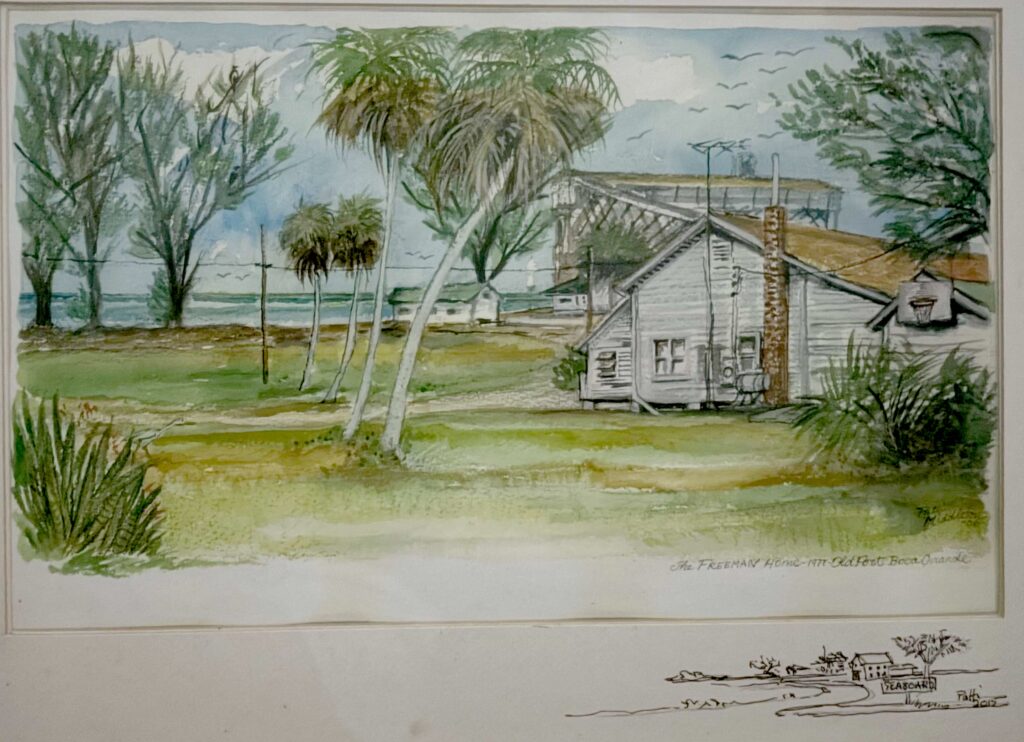
At the time, Tommy said the port had over three dozen staff. The family lived in a frame railroad cottage located where the Boca Bay lake is now.
Freeman was a deacon at First Baptist Church of Boca Grande, where he and Nancy taught Sunday School. His late mother worked many jobs on the island, including a time at the Boca Grande Health Clinic. She also filled in as elevator operator at The Gasparilla Inn. Freeman wrote poetry and recorded songs with son Tommy, as well.
As it was so much defined in his character, Joe was the consummate gentleman, demonstrating immense southern charm. He would rush to be the first to stand, as “a gentleman cannot remain seated if a lady does not have a seat.” He loved to camp, had a passion for learning, especially history, played tennis and was an excellent bowler.
After working 36 years with the railroad, he went on to volunteer at the Shriner’s Hospital for 16 years. During this time, he attended the University of South Florida taking a host of continuing education courses. His sons stayed in the area, and Freeman came back for talks with the Boca Grande Historical Society.
As father and grandfather, he loved and was deeply loved by all of his family. Joe is survived by his two sons, Joe “Joey” M. Freeman, III (daughter-in-law, Tyra) and Thomas “Tommy” Alan Freeman; seven grandchildren (Joe, Keith, Stefani, Sarah, Josh, Amanda, Kelly); and nine great grandchildren (Jenika, Killian, Everly, Liam, Lily, Graham, Ellis, Braylee, Renleigh).
In the first Beacon
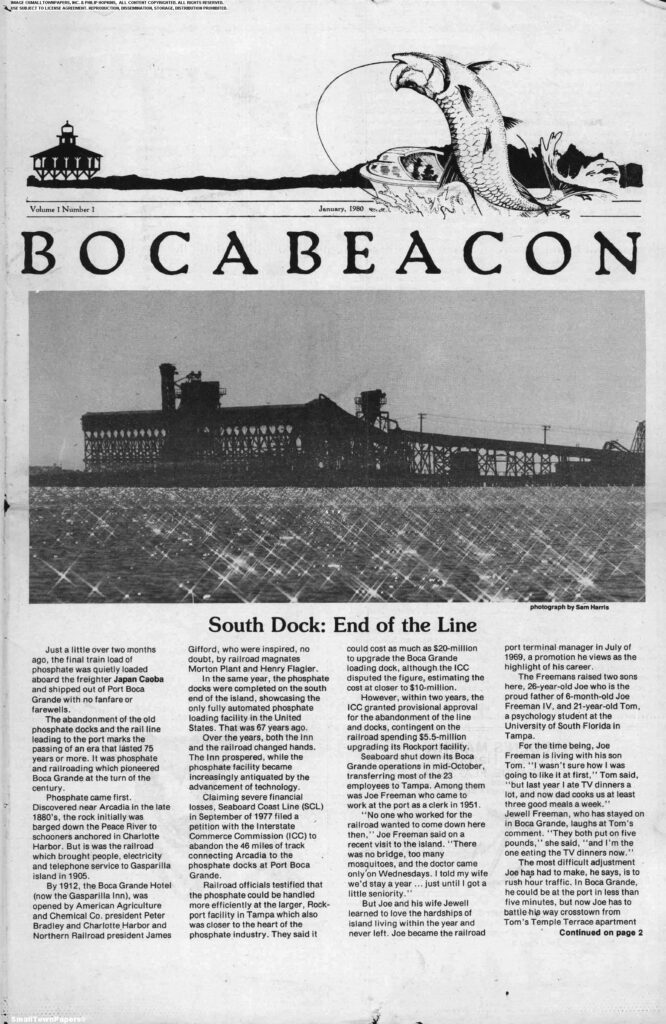
Joe Freeman was on the cover of the first edition of the Boca Beacon, in January 1980, Volume 1, Number 1, under publisher Marnie Banks. The Beacon wrote:
“No one who worked for the railroad wanted to come down here then,” Joe Freeman said on a recent visit to the island. “There was no bridge, too many mosquitoes, and the doctor came only on Wednesdays. I told my wife we’d stay a year … just until I got a little seniority.” But Joe and his wife Jewell learned to love the hardships of island living within the year and never left. Joe became the railroad port terminal manager in July of 1969. The story ended with the closure of the dock:
“After 28 years with the railroad, Joe understands the necessity of closing Port Boca Grande, but he fears the whole character of the island will change now that these foreign ships no longer dock at the port. ‘It was not unusual to walk into the drug store and see some Greek sailors trying to buy something in broken English,’ he said, ‘and it was always amusing watching Norwegian sailors trying to mix with the crackers at the Pink Elephant.’”


