


OPINION: Placida apartments and Coral Creek protected wetlands

BY ROB ROBBINS PRESIDENT, FRIENDS OF CAPE HAZE
On Feb. 9, the Charlotte County Planning and Zoning Board voted 4-1 to forward on to the Charlotte Board of County Commissioners a recommendation to rezone by Hutton MF Cape Haze LLC. The rezoning would allow a 135 unit apartment building behind the Cape Haze Ace.
The proposal would amend the Charlotte County Zoning Atlas from Residential Multi-Family 12 (RMF-12) to Planned Development (PD). It would require the transfer of density units for residential development above the current density of 108 units.
At top, the rezoning sign; Christian radio station WSEB tower is in the background.
Friends of Cape Haze; file photo
Following last week’s hearing, the Friends of Cape Haze is challenging the preliminary, non-binding approval of the Hutton proposal, arguing the decision was based on a false premise. During the proceedings, the applicant claimed that if the current, larger project were not approved, they would proceed with a “previously authorized” version of the site plan by right. This argument appeared to sway the board—most notably board member Robert Segur—who suggested that approving the current plan was the only way to ensure higher standards than the “inevitable” smaller project.
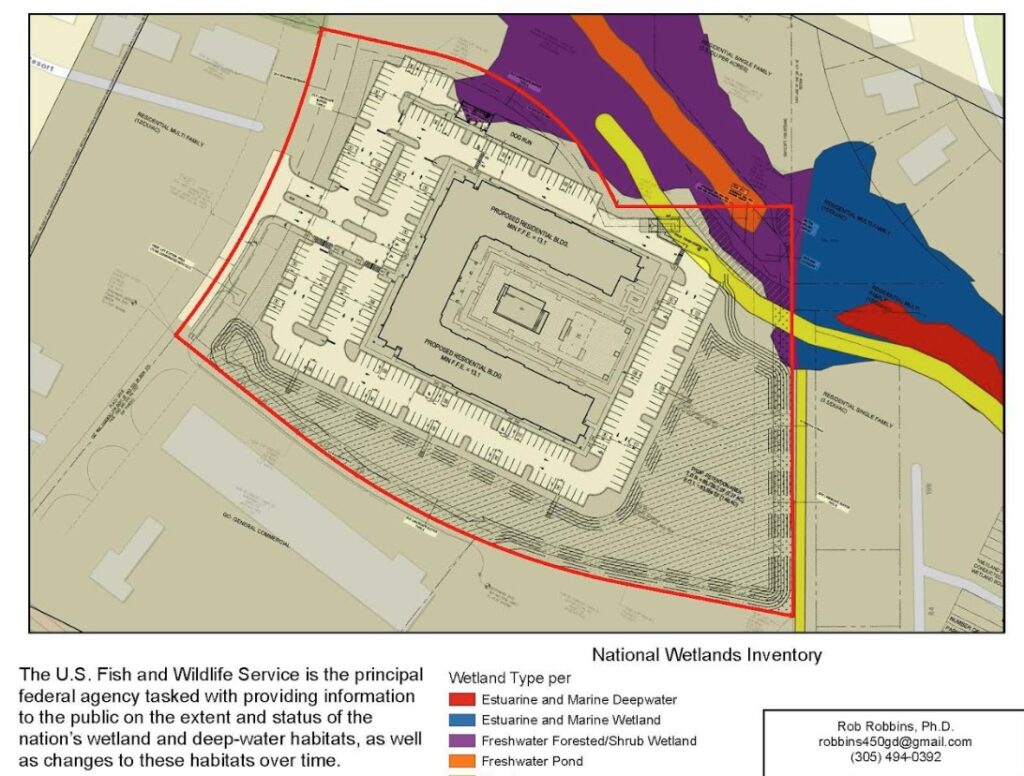
However, official records from the Southwest Florida Water Management District (SWFWMD) prove this “fallback” project does not legally exist. The previous application was never approved because the developer failed to provide required environmental data or address the significant wetlands on the property. As the proposal moves to the Board of County Commissioners in March, it is critical to recognize that no “shovel-ready” alternative exists and any development on this site must meet today’s stricter statewide water quality rules and mandatory wetland protections.
The Planning Board was sold a bluff. The developer claimed they had a ‘fallback plan’ ready to build, but SWFWMD records prove that is a fiction—their previous attempt was never approved and completely failed to address the protected wetlands on-site.
FoCH has created the website capehazewetlands.com to keep the public informed.
Rob Robbins, PhD, is president of Friends of Cape Haze. He has a background in marine biology and fisheries with an emphasis on coastal mangrove fish ecology.


