


License to Speak: Former MI6 chief brings spy stories to Boca Grande

Above, Sir John Scarlett with his wife, Gwenda, after the talk at the Boca Grande Community Center. Photo by Garland
Sir John Scarlett ran Britain’s MI6. On Friday, he came to the Boca Grande Community Center to talk about Russia, Ukraine, Donald Trump and the war with Iran.
The former spymaster couldn’t name names or burn sources, but he did not need to as his sold-out talk, entitled “Russia, Ukraine and the Echoes of History,” carried the authority of someone who had been in the room during history, knowing Russia and the old Soviet Union over its most compelling time.
Scarlett also couldn’t discuss his tenure atop MI6 from 2004-09 in detail. That is good form for a spymaster (his first question was about running agents), but a bit of a pity, as he is noted in history books as having befriended the most famous double agent of modern time, Oleg Gordievsky, who helped hasten the end of the Cold War, but was betrayed, and had to escape from the USSR.
He did acknowledge a role in history. “And I did have, and I was very, very privileged to have a role, at a central role in one particular case, which I’m not going to talk about in detail, but it’s sort of known about,” He paused. “That certainly was a high point for me.”
Heads of MI6 are called “C” (M is just in the Bond movies) for Chief. Scarlett served in Russia as Moscow Station Chief from 1991-94, and previously served there in the 1970s.
“You’re dealing, in this case, with the penetration of the KGB and access to really deep inside information, which told you things really, not just about the activities of the KGB and what they were doing, trying to do this and trying to do that, and they weren’t that great, actually but also the thinking, the mindset of the influential people in the Soviet Union at that time.”
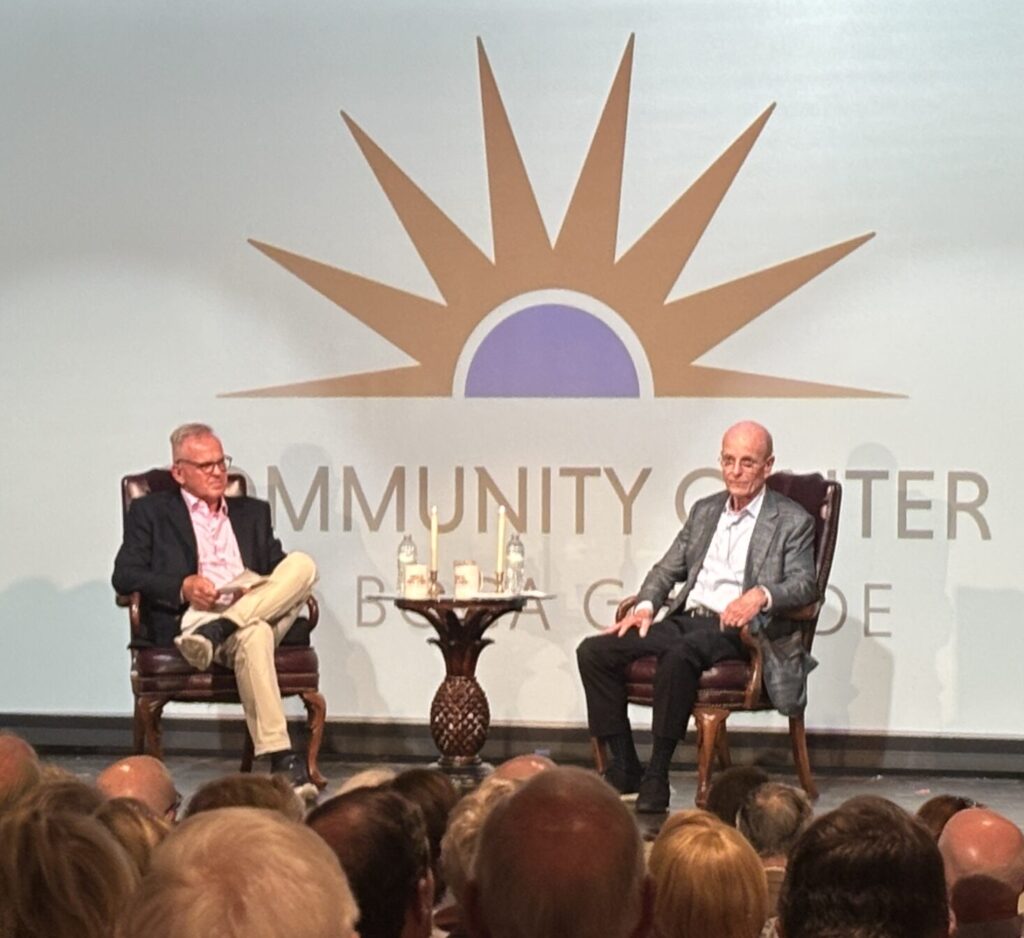
He was questioned by Simon Bound as part of a Friends of Boca Grande event on Friday, March 7.
“Nobody, absolutely nobody, was thinking or foreseeing that the Soviet Union would collapse. I mean, it just wasn’t,” Scarlett recalled. “If you weren’t careful, or unless you were doing a job like mine, it was a bit boring because you were under such tight control, and the whole society and the whole city was under control. And it really was. For example, there were no commercial adverts in the streets. There was no street life really. There were no cafes or restaurants. There were just lots and lots of apartment blocks.”
That is not to say there was not intrigue.
“I mean, we were just followed around everywhere down to my car, and automatically three cars were following. I did feel quite important,” Scarlett quipped.
He has since learned that with a command economy, it can collapse almost overnight. “It sort of crumbles, or if that control weakens, it cannot just adapt, it collapses,” Scarlett said.
Scarlett talked extensively about Putin, who he was clear to say that he had been with, but not met. “Well, he is an autocrat, of course, and that’s putting it quite kindly,” Scarlett said. “That is a country which expects strong, strategic leadership. It looks to its leaders. That guy has got to be manifestly, almost autocratic, to be respected. That’s natural for Russian society.”
Knowing the importance Putin puts on prestige is important in dealing with him.
“It’s greater Russia, and that goes back to the Tsar. So it goes back to the Empire, goes back to the creation of Russia as this great territorial entity, by far the largest in the world, which happened over a few hundreds of years.”
Of Trump, Scarlett surmises that Putin sees him as an “unpredictable leader” and “he doesn’t quite know what he’s going to do next, what particular situation he will get into, or what particular situation he might provoke, or whatever. And so from that point of view, of course, it’s potentially tricky relationship.”
Taking Putin seriously is important. “Even if he finds himself in the confrontation in statements or whatever, for example, over the Iran thing with the United States, he’s careful not to be provocative, as far as President Trump,” said Scarlett.
Bound referred to an investor conference where Sir John spoke on Ukraine, just before the Russian invasion, describing the mood as “dark” and believing Putin was going to strike. While many had predicted that Putin would not invade, Scarlett saw a different atmosphere.
“I went to Moscow for three days, and from the 14th, the 17th of February, and I went as part of a small team, five of us. On behalf of my think tank, the Royal United Services Institute, but also on behalf of the Foreign Office. The Foreign Office were keen for me to go. Although they were telling me that there was going to be, there were definitely going to be an invasion attack on Ukraine, and it might get risky, but they were very keen for me to go. And I remember that afterwards, because when I got back, there was an Oh, thank goodness you’re back safe. Thanks for telling me that before I went.”
Other Europeans, and even Volodymyr Zelenskyy, did not believe it would happen. They had misinterpreted. Putin did put his philosophy of the invasion into an online essay, which Scarlett referred to in the talk. Putin referred to Ukrainians and Russians as one people, not two. Another factor was the American retreat from Afghanistan in August 2021.
“He saw that withdrawal, and of course, that was telling him something about the mindset of the West, including United States,” said Scarlett. The overall result has been devastating for both sides, with the number of dead or wounded at 1.2 million, all at a “huge cost” for “very small” advances in territory.
“I mean, these are first world war time figures, obviously,” Scarlett said.
Of the new Iran war, Scarlett believes a first response from Putin on the war in Iran will be not unfavorable.
“When you look at it, after one week, probably they’re pretty pleased. The fundamental reason for that, clearly, is the impact on oil and gas prices. Oil and gas and fossil fuels, this is the foundation of the Russian economy,” Scarlett said. “Potentially, they could be big beneficiaries of it.” He also reminded that the interest in Iran by the U.S. would be a “distraction” in the situation with Ukraine. There is also a strengthening of Russia’s position.
“It’s also possible to go around the world and say here we have Western aggression, and American imperialism and that adds to their sort of message,” Scarlett said.


