


Lee County license plate readers to remain at Causeway

In 2024, the Lee County Sheriff’s Office installed two automated license plate readers, or ALPRs, at the Gasparilla Island Bridge Authority.
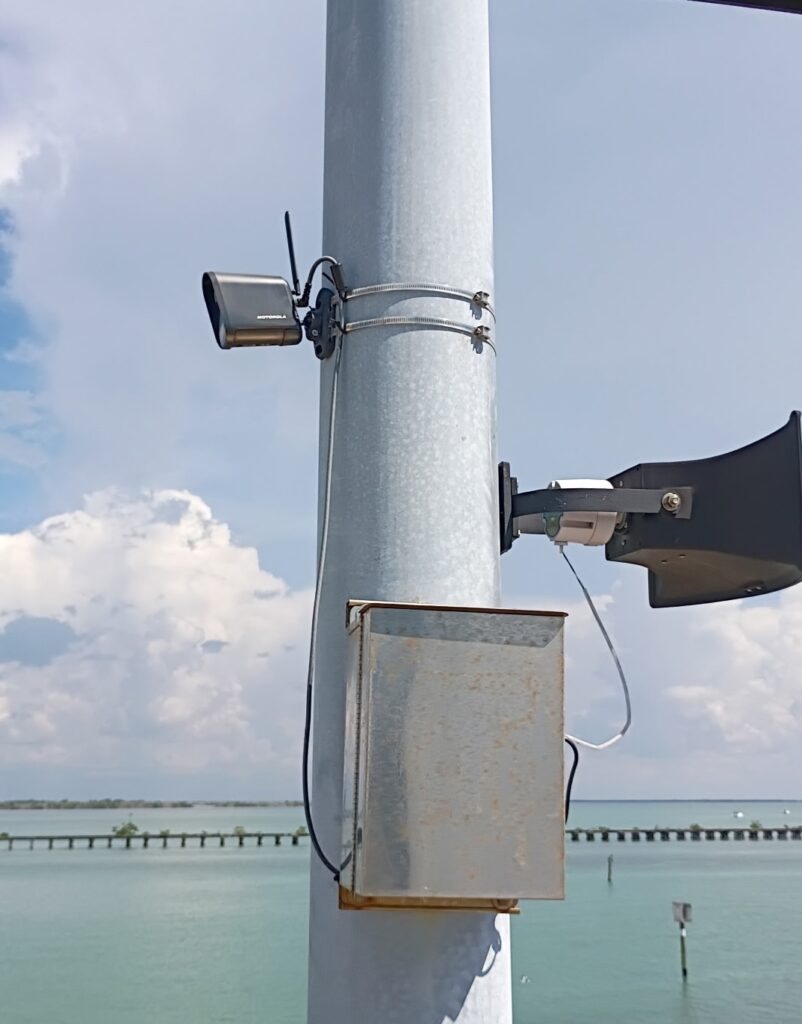
The trackers are on the swing bridge in both directions. Technically, they are not Flock-branded cameras, but Motorola Vigilant model LPRs, as the logo is visible.
On Aug. 31, Will Watts, chief operating officer of the Florida Department of Transportation, issued memo 26-01, on behalf of Gov. Ron DeSantis. The memo to local agency permit holders revoked all permits located on state right of ways. The memo cited “recent exponential increase in deployments along our roadways, coupled with concerning reports of misuse, data privacy concerns, and surveillance schemes merit immediate action to preserve Floridians’ sovereignty and quality of life.” The memo also said the state would remove them if they were subject to the memo, and looked forward to using its discretionary authority to “cease the issuance of all future requests for LPR systems within its jurisdictional authority.”
On the Boca Grande Causeway, the license plate readers are mounted on poles on the stoplights on either side of the swing bridge. While they were approved at the May 2024 GIBA meeting, the Bridge Authority does not run or control them. The authority does, however, track cars and photograph car transactions at the toll plaza. It is not a state highway or right-of-way, but County Road 771.
The LCSO responded to a query from the Beacon.
“There is no doubt that technology can be a double edged sword,” wrote Anita Iriarte, LCSO’s commander for public affairs in an email. “While it has helped us in major investigations and locating missing persons, we must understand the general public’s fear of misuse.”
The Beacon asked specific questions, including what the retention period is for data collected by this camera that law-enforcement agencies have access to, and confirming the manufacturer, Motorola, as the company’s branded trucks were spotted out on the bridge. Ariate wrote that the LPRs are in compliance with the state memo, and comply with Florida Statute 316.0778 in reference to data retention. According to the Florida files, “data and images must be retained no longer than three anniversary years.”
“We will comply with the orders by our State partners while the legislature straightens the rules and regulations regarding the use of certain technologies,” Iriarte wrote. “Our hope is that they move quickly so as to not jeopardize public safety.”
Lee County has an agreement with the LCSO, signed Feb. 18, 2020, that governs how LPRs are placed on county roadways. In the agreement, the county provides access for the cameras, but has no ownership rights, and is allowed to maintain a live map of any device. The devices are installed with the cooperation of the county’s Traffic Operation Center.. The effort came out of the LCSO, when they approached the Lee County Department of Transportation. The cost to add a new pole could be upwards of $50,000, so co-locating was cheaper. The LCSO pays the DOT $25 per month, per location, according to the board action.
Across the state, Florida jurisdictions are stripping down the cameras, including 72 license plate readers from state highways in Collier County, while the Cape Coral Police Department shut down its camera use entirely.
Charlotte County Public Information Officer Chris Hall said, in an email to the Beacon, that they do not have any data. “Those cameras all belong to Lee County,” Hall said. “We do not have access.”
Charlotte County Sheriff Bill Prummell criticized DeSantis’ position in a statement. “Again, politicians are having knee jerk reactions to something that really isn’t a problem and not looking at what the true benefit of this technology is and how it is being used,” he wrote at the beginning of the month. “If there are people abusing this system, we need to hold them accountable just like we do for any other criminal justice system they have access to.”
He said in the statement that the action “seriously crippled law enforcement by limiting the use of a great crime fighting tool.”
Editor’s Note: This article was updated from the print edition of Sept. 18 to include comment from Charlotte County, and to fix the mis-spelling of Iriarte’s name.


