


IN THE SPOTLIGHT: Capt. Chris Slattery

Constructing a career as fishing guide
In his nearly two decades on the water, Chris Slattery has turned his lifelong passion for fishing into a career as one of the area’s trusted inshore guides.
Capt. Slattery has been a leading fishing guide in and around Boca Grande, Lemon Bay and Pine Island with his company, Reel Intense Inshore Charters.
“There’s no place like this,” Slattery said. “It’s a secret in Florida that’s been kept for a long time, and it’s starting to be that the secret’s starting to get out.”
Slattery grew up here and attended Lemon Bay, graduating in 1997. At first, he went into construction as a framer, eventually getting his contractor’s license. He later became a construction supervisor for a custom homebuilder in North Port.
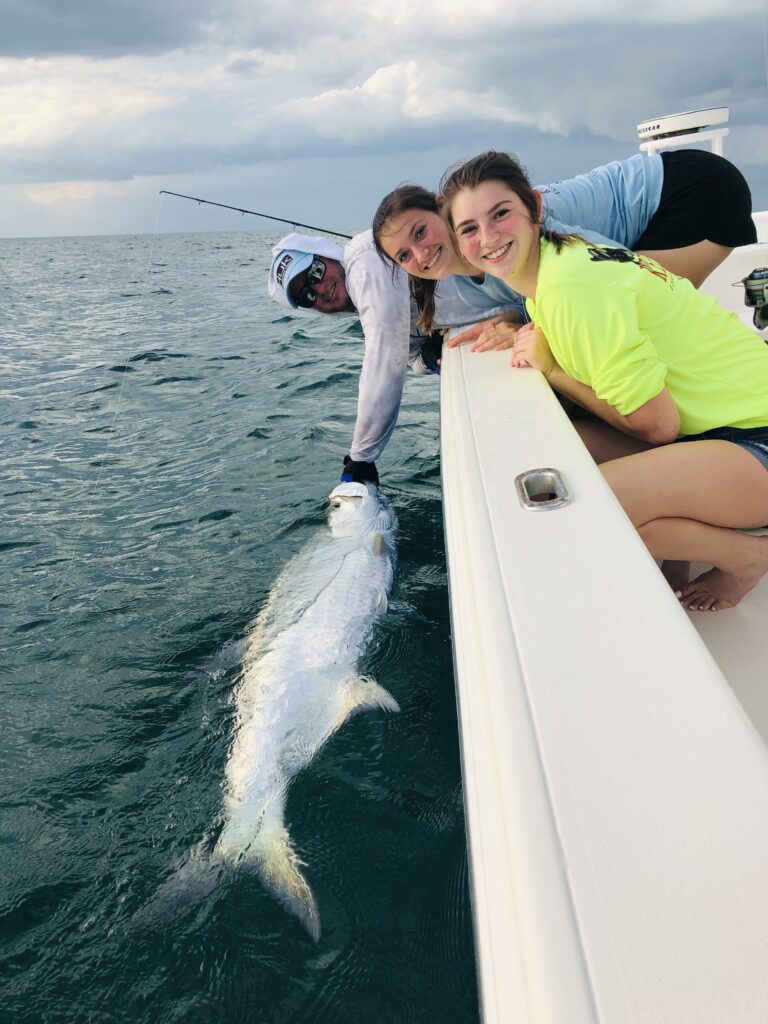
But through it all, he fished with friends, including tournaments. When the economy crashed in 2008, he decided to get his captain’s license, starting full time in 2010. His wife, Christina, was not so sure.
“She thought I was nuts,” Slattery said, “but she supported me.” The first years were tough, but he says now that he would not change the path for the world. “Even when I was making a lot of money in the construction industry, I just never enjoyed getting up and going to work,” Slattery said.
He and Christina have two daughters, Shawna, 25, and Kirsten (Kiki) who is 24. They both grew up on the water.
“Those girls would hop on the boat with pub subs. They’d go pub subbing and they’d bring out subs after I ran a double, and we’d go out and dip crabs until the sun would come down,” Slattery said.
Both daughters are married, one to a med school student and the other to a Delta pilot. Slattery hopes one day to have them back close to home. One has twins and the other one is due in September with her first child.
He looks forward to taking his grandkids out to dip for crabs, as well.
“I can’t wait till my granddaughters get to an age where they can do it,” Slattery said.
He is one of about three dozen members of the Boca Grande Fishing Guides, a group dedicated to ethical fishing in the Pass. It is a challenge getting all the guides together, and it is difficult to agree on things as they are all competitors.
“We all have to start with working together first,” Slattery said. “I think that’s what makes it hard for everyone to be on the complete same page.”
What it looks like to be a guide has changed over the years. He has had to adjust to the diminished fishery in once-abundant waters. He lets his clients know about the unavailability of certain fish.
“My clients have adapted to the fact that I tell them I’m not keeping redfish,” Slattery said. That is true for other fisheries as well. It is a challenge, however, as he gets calls during snook season, where customers want to, well, get a snook.
“I don’t,” Slattery said. “I’m sorry. I’m not keeping a snook.”
The other thing is that social media has changed the marketing. In the past, if you came down to Gasparilla Island to find a guide, you’d go to a tackle shop and ask, or you would get a recommendation from a friend.
“I have to post more of my daily life,” Slattery said. “My clients enjoy watching it. People that aren’t my clients that are prospective clients enjoy watching it.”
The water is one place where children will put down the electronics and have time together. That has been true for his family, and the others who come on charters.
“It’s one of those things that when you’re on a boat, you’re just happy to be on a boat,” Slattery said. “They [children] put their phones in the cubby, and they’re ready to be out there and enjoy the experience.”
The diminished catch
The typical charter customer understands the nature of the fishery and its expectations. “You can’t control the fishing,” Slattery said. “You do the best you can. You work hard. People are just happy to be on the water.”
He is not opposed to a larger enforcement presence on the waterways, which he realizes can seem controversial.
“Charlotte County is out there all the time, and they’re dealing with the traffic enforcement and this and that. But when it comes to the fishery, I don’t think we have a very good presence,” Slattery said. “I’d like to see the state up the amount of people that are out here. [To] figure out a way to fund this.”
The visitors who come here are often just happy to be on the water and away from the cold. The have reconciled with the fact that things have changed.
“If we catch 100, we catch 100. If we catch 10, we catch 10,” Slattery said.
The redfish population is dear to his heart, and it has gone from a time when there were 50 to 75 redfish a day.
“We would catch 50 redfish, and now we’re only catching five a trip,” he said.
He has over a dozen redfish tournament wins in his career, even when there were over 100 boats entered.
“I had hoped that after all those closures and what had happened, some of these redfish, the fishery would come back a little bit,” Slattery said.
There are other options. For inshore species, he reminds that trout grow quickly and they spawn three times a year.
“So, I think trout is something that we can keep,” Slattery said.
Part of his concern is that in the few decades that he has been fishing here and working as a guide, the entire fishery has been diminished. The 2018 red tide kill felt like it was toxic spill, and not an environmental event, he said. While a fishery can be resilient, like humans, there is only so much it can take. The new groups that have come out to support the fisheries have been a help to the cause, including Captains for Clean Water.
And not all is gloom. He has observed the turtle grass coming back alongside the water quality.
Statewide, few fisheries are truly thriving. Earlier in his career he fished tournaments, including the Inshore Fishing Association. The East Coast still suffers.
“Their red fishery is not nearly as good as it used to be. Mosquito Lagoon is not the Mosquito Lagoon of the old,” Slattery said.
A career on the water is not always easy. During Ian, he survived picking up odds and ends and doing demo work, including tearing down “a lot of pool cages.”
There have been lulls, but he calls this place magical, and a place he will never leave.
“I thank God every day for the opportunity to do this,” Slattery said. “I don’t think there’s anything better than [watching] the sun coming up on the water and smelling that salty air.”


