


History: Rededicating to ‘We Hold These Truths to Be Self-Evident’
BY JAMES J BLALA, BOCA GRANDE HISTORY CENTER
As the United States celebrates 250 years of the signing of the Declaration of Independence, what is the best way to commemorate this unique event in a meaningful way? Many will celebrate by participating in or observing parades, firework displays, concerts, dramas, movies, attending lectures and reading books. Others might decide to devote their commemorative efforts to a rededication to the ideas which ultimately led to the War for Independence, and the creation of a nation which, despite some internal and external conflicts and challenges yet to be resolved, can still claim its status as being “Exceptional.”
American Exceptionalism is the belief that the United States is unique and has a special role in the world. The term “exceptional” was initially used by Alexis de Tocqueville during the 1830s when he wrote that the United States was a unique nation consisting of immigrants and the components of a modern democracy. Some scholars have argued that “exceptionalism” has its roots in a mission to exist as a “City Upon the Hill” or a shining beacon for the rest of the world.
Proponents of American Exceptionalism believe that expansion was a God-given mission to spread American ideals, liberty and representative government. Revisionist historians, however, argue that issues relating to Native American communities, slavery, foreign relations, etc., were either ignored or addressed under the existing guidelines of expansionism. (For more information about challenges to “American Exceptionalism” read H. Zinn’s book “The Myth of American Exceptionalism.”)
The War for Independence was more evolutionary than revolutionary. Many of our founders were students of the American Enlightenment, which was an 18th-century intellectual and philosophical movement that contributed to the basic political principles of the American Revolution and the creation of the United States. European thinkers, including John Locke and Isaac Newton, influenced the mindsets of American leaders such as Thomas Jefferson, Benjamin Franklin, Thomas Paine and others.
The key principles of the American Enlightenment included natural rights, republicanism, reason and rationalism, separation of powers and religious tolerance. Our nation’s founding documents such as the Declaration of Independence and the Constitution are extensions of Enlightenment thought. The American Revolution was the inevitable application of Enlightenment principles to the 13 colonies during years when the colonists had previously experienced lax enforcement of British mercantile and political regulations. Enlightenment principles were not new, but using these principles in practical application to a vibrant community was new or rather “Exceptional.”
Another anniversary commemorative activity is to re-read many of the founding documents upon which our nation is based. Two documents that are worthy of rededication are Thomas Paine’s “Common Sense” and The Declaration of Independence. Literature of the European and American Enlightenments constituted an intellectual challenge to many of the colonists. Therefore, the goal of some of our founders was to transform intellectual literature into practical proclamations which clearly justified rebellion.
One of the most inspiring rationales for seeking independence was Thomas Paine’s “Common Sense.” Published on January 10, 1776, it motivated everyday Americans to begin thinking seriously about independence. Thomas Paine put the rhetoric of the educated class in a language that people in taverns, coffee houses and around the kitchen table could understand. It also provided a plan or a vision for a new society which would be based upon principles of personal freedom and social equality. Arguing that an island could not rule a continent, Paine boldly proclaimed that the British monarchy was corrupt and unjust, and that the time for reconciliation was over. He also urged the colonists to fight for their freedom. Many colonists were inspired by this treatise, thus increasing support for the struggle for independence.
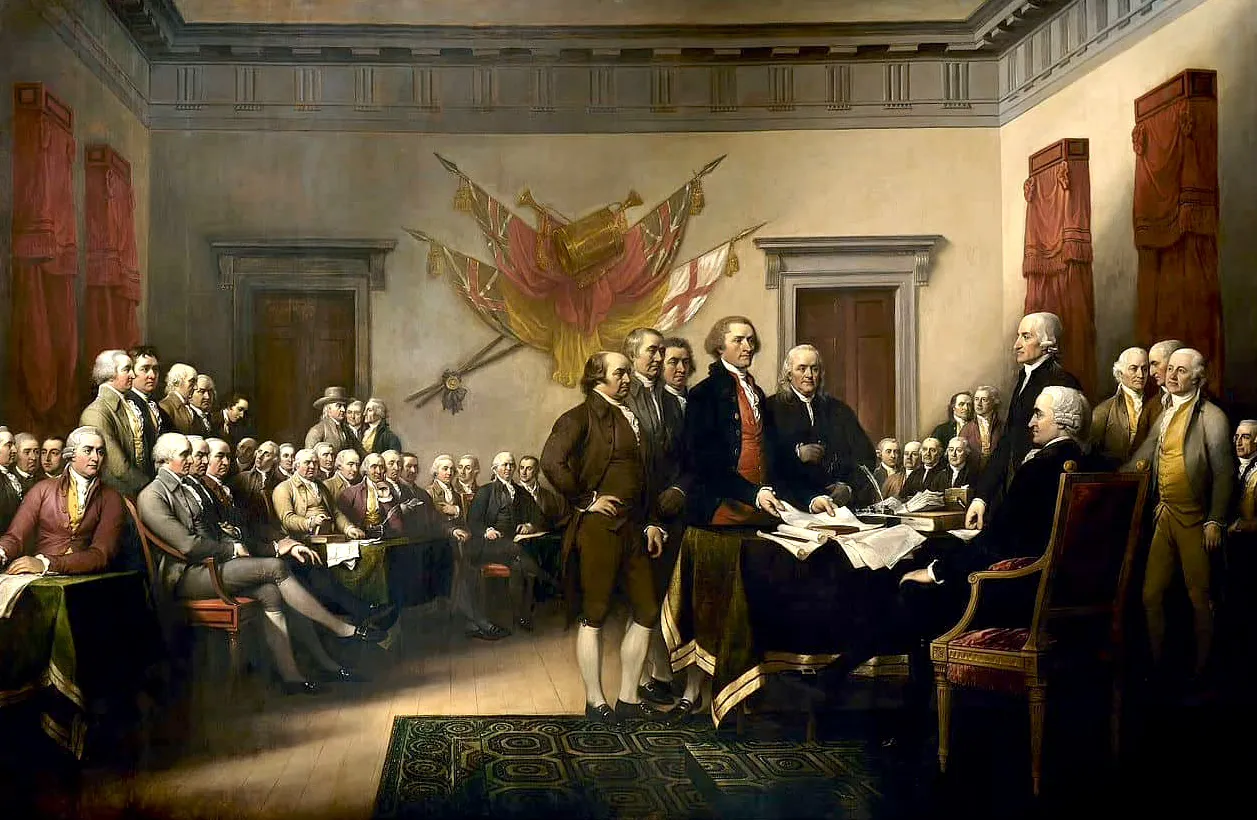
The Declaration of Independence, as written by Thomas Jefferson, is a masterful combination of previously identified Enlightenment principles with a specific rationale for separation from Great Britain. “We hold these truths to be self-evident.” Why are these truths self-evident? It is because “the Laws of Nature and of Nature’s God entitle them.” These truths include that “all men are created equal, that they are endowed by their Creator with certain unalienable Rights, that among these are Life, Liberty and the pursuit of Happiness – that to secure these rights, Governments are instituted among Men, deriving their just powers from the consent of the governed.”
Again, the rhetoric is from Enlightenment principles. However, what is “exceptional” is the application of these principles as a basis for creating a new nation. Jefferson continues this rationale for rebellion by listing specific grievances and finalizes the Declaration by stating, “And for the support of this Declaration, with a firm reliance on the protection of divine Providence, we mutually pledge to each other our Lives, our Fortunes and our sacred Honor.”
Proclaiming independence based upon Enlightenment principles does not automatically guarantee independence. Former scholar and President John Adams is reported to have said that only one-third of the American colonists supported the War for Independence. Some historians have estimated that 15 to 20 percent of the colonists were Loyalists and actively supported the British by serving in the military, acting as spies or helping the British military forces. It has been estimated that 25,000 Loyalist troops supported Great Britain. What were the chances of a minority of people in 13 scattered colonies winning a war against at least 48,000 British troops in North America and maintaining a large naval force mainly consisting of frigates and sloops?
Obviously, many factors contributed to winning independence: British colonial policies; rising costs causing a heavy tax burden in Great Britain; a lack of decisive war-ending battles; financial and military support for the colonies from foreign nations; and strategic colonist victories such as the Battle of Yorktown constitute just a few of the many reasons for a successful American rebellion.
The colonial victory at Yorktown was the last major battle in the War for Independence. The Treaty of Paris (1783) formally granted independence to the United States. The Articles of Confederation (ratified in 1781) is considered the United States’ first constitution. However, the Constitution as written in 1787, ratified in 1788 and modified by amendments (including the Bill of Rights) is still in use. “We the People” (from the Preamble) means that the government exists to serve the people and that its power is derived from the people. Serving the people mandates continued efforts to evidence progress in the application of Enlightenment principles to gender, racial, ethnic and religious communities. Political differences should be tolerated and respected and should promote the common good.
How should the Nation celebrate 250 years? Retired Supreme Court Justice Stephen G. Breyer states in his book, “The Promise of America: Reflections on Our Enduring Ideals,” that “We want a system that is not driven by … the self-interest of individual factions. We want a system that will promote deliberation and debate.”
Pulitzer-Prize historian Gordon Wood wrote in his award-winning book, “Friends Divided: John Adams and Thomas Jefferson,” that “Jefferson offered Americans a set of beliefs that through the generations have supplied a bond that holds together the most diverse nation that history has ever known … nothing but Jefferson’s ideals can turn such an assortment of different individuals into the one people that the Declaration says we are. To be an American is not to be someone, but to believe in something.”
The experiment and evolution of Enlightenment principles in promoting the common good continues. This is the essence of “American Exceptionalism.”


